
TALK TO AN EXPERT
Our team of experts are available to talk to Mon-Fri 08.30-17.30 and Sat 10.00-14.00
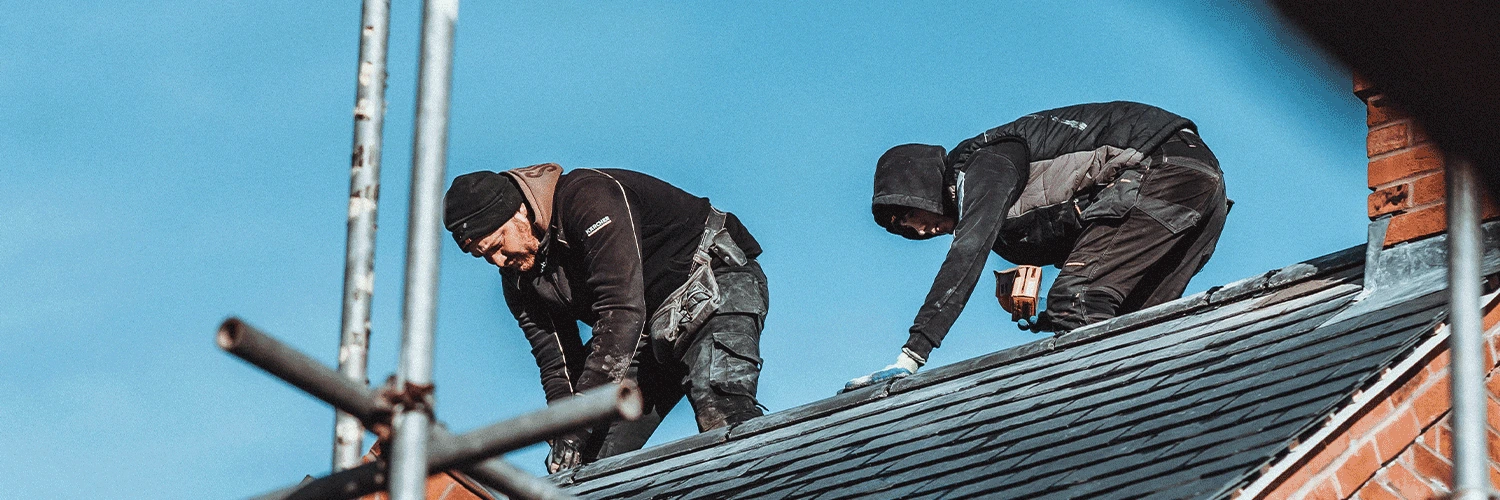
From stripping and re-laying roof tiles to replacing felt and repairing flashings, roofers carry out some of the most physically demanding and weather-dependent work in the trades. You're up on the roof in all conditions, often working alone or with a small team, keeping properties watertight and structurally sound.
Here at Rhino, we provide cover for roofers across Public Liability Insurance, Employers' Liability Insurance, Tools Cover, Contractors All Risks and Personal Accident Insurance.
Looking to get covered? You'll find everything you need to know on this page, or, if you want to dive right in, give us a call at Rhino HQ!
Roofers' insurance is a specialised type of cover designed to protect roofers against risks they face whilst undertaking their work, including damages, injuries, and legal claims.
There are numerous policies that can protect you as a roofer. From the core cover of Public Liability Insurance to the legally required Employers’ Liability Insurance if you have a team. You can also protect your tools from theft with Tool Insurance, and protect yourself should you be forced off the tools through illness or injury with Income Protection Insurance and Personal Accident Insurance. There are various policies that can help provide the relevant cover for you and your business.
Here's a rundown of the key types of cover available to roofers through Rhino.
Public Liability Insurance is the cornerstone of any roofer's cover. If a member of the public is injured or property is damaged as a result of your work, Public Liability Insurance covers the compensation and legal costs that follow.
Think of a tile dislodged from a roof landing on a parked car, or ladders or materials left on the pavement causing a trip. One incident at height can result in a significant claim. It’s also important to note that most contractors and clients will want to see your Public Liability certificate before you start.
Your Public Liability Insurance through Rhino covers accidental injury to third parties, accidental damage to third-party property, legal defence costs and court attendance costs. It also extends to bona fide subcontractors working on your behalf, provided they hold their own Public Liability Insurance.
If you employ anyone, whether full-time, part-time or even a casual labourer brought on for a single job, you are legally required to have Employers' Liability Insurance. It covers you if a member of your team suffers an injury or illness as a result of their work for you.
The cover includes employees, labour-only subcontractors and temporary workers. It also includes legal defence costs and compensation for court attendance if a claim leads to proceedings.
There are no exceptions here: if someone is working for you in any capacity, you need this in place before they start. You can read more on our Employers' Liability Insurance page.
Your materials and work-in-progress represent real money. Contractors All Risks Insurance protects the materials and completed work on a job against accidental damage, theft and storm damage right up until the work is finished for your client.
If a half-finished roof is damaged by an overnight storm, or materials are stolen from site, Contractors All Risks cover means you're not starting again at your own expense.
Without your tools, you’re not working. Tools Cover protects your hand tools, power tools, ladders and associated equipment against loss, theft and damage. If your tools are stolen from your van overnight, tool insurance covers the cost of replacing them, subject to depreciation, so you can get straight back to it.
Head to our Ultimate Guide to Tools Insurance for a full rundown.
Disputes happen in business, whether that's a client refusing to pay for a completed job, a contract that's gone sour or an employment issue with a member of your team. Legal Expenses Insurance covers the cost of taking or defending legal action, so you're not weighing up whether you can afford to pursue what you're owed.
For a sole trader or small roofing business, having access to legal support without racking up legal fees can make a real difference. It's a relatively low-cost addition to your policy and one that earns its keep if you ever need it.
Roofing is a physical trade. If you're injured and can't work, Personal Accident Insurance provides a weekly benefit to help cover your income while you're off your feet. It's a practical safety net that many sole-trader roofers overlook until they need it.
Rhino uses a different underwriter for its roofers' insurance, who quote roofers on a case-by-case basis, so getting a quote via the quote engine isn’t possible. Every roofer's situation is different, and we want to make sure you get the right policy at the right price rather than a one-size-fits-all answer.
Give us a call, and one of the team will talk through your work and put together a personalised quote for you. It's a quick conversation, not a long sales call.
Call us on 0116 243 7904 — Monday to Friday, 8:30am to 5:30pm
This is an important one. If your roofing work involves hot works - using blow torches, hot air guns, heating bitumen or applying hot-melt felt systems - this is not covered under the Public Liability Insurance available through Rhino.
Hot works significantly increase the risk of fire and are excluded from the Public Liability section of this policy. That applies to:
Blow lamps and blow torches
Hot air strippers and hot air guns
Vessels for heating bitumen, asphalt, tar or pitch
Any other open-flame or heat-generating equipment used as part of your roofing process
If hot works form part of your day-to-day work, it's essential you tell us when you call. Causing damage to a property through the use of heat, for example, would mean that you aren’t covered for the damage caused, and your business would have to foot the bill.

Because roofing is assessed on a case-by-case basis, there's no fixed price list we can point you to. Your premium will depend on a number of factors, including:
The type of roofing work you carry out
Your annual turnover
Whether you employ anyone (and how many people)
The Public Liability limit you need (typically £1 million, £2 million or £5 million)
The value of your tools and equipment
Whether you need Contractors All Risks cover, and the size of your typical contracts
The quickest way to get a price is to call us. Our team will ask you a few straightforward questions and come back to you with a clear, no-obligation quote.
There's no legal requirement for self-employed roofers to hold Public Liability Insurance, but in practice it's essential. Most clients, main contractors and housing associations will ask to see your certificate before you start any job. Working at height means the consequences of something going wrong can be serious, and a single claim without cover could leave you personally liable for significant costs.
Rhino uses a different underwriter for roofing insurance, who deals with roofers on a case-by-case basis. Whilst getting a quote may not be as quick as in other trades, it does mean we can ensure your policy fits the exact type of work you carry out. Give us a call, and we'll get you a quote sorted.
Yes. Your Public Liability Insurance extends to cover your legal liability for work carried out by bona fide subcontractors working on your behalf. The key condition is that they must hold their own Public Liability Insurance with an adequate limit of indemnity, and you should keep a written record of this.
Yes. The policy covers your roofing work across Great Britain, Northern Ireland, the Channel Islands and the Isle of Man and doesn't exclude working at height as standard. The hot works exclusion is the key limitation to be aware of - see the section above for details on that.
This is exactly the kind of situation where a conversation with our team makes sense. Give us a call and we'll talk through the nature of your work to find out what cover is available and what limitations apply. The important thing is not to assume you're covered for hot works without checking first.
It depends on the nature of the arrangement. If the subcontractors are genuinely self-employed and supply their own tools and materials and work without direction from you, you may not need Employers' Liability Insurance for them. But if you supply their materials, direct their work or they're labour-only, they may legally be classed as employees. If you're unsure, call us and we'll help you work through it.
Tell us your trade and get a tailored insurance quote for your business in seconds
Our team of experts are available to talk to Mon-Fri 08.30-17.30 and Sat 10.00-14.00